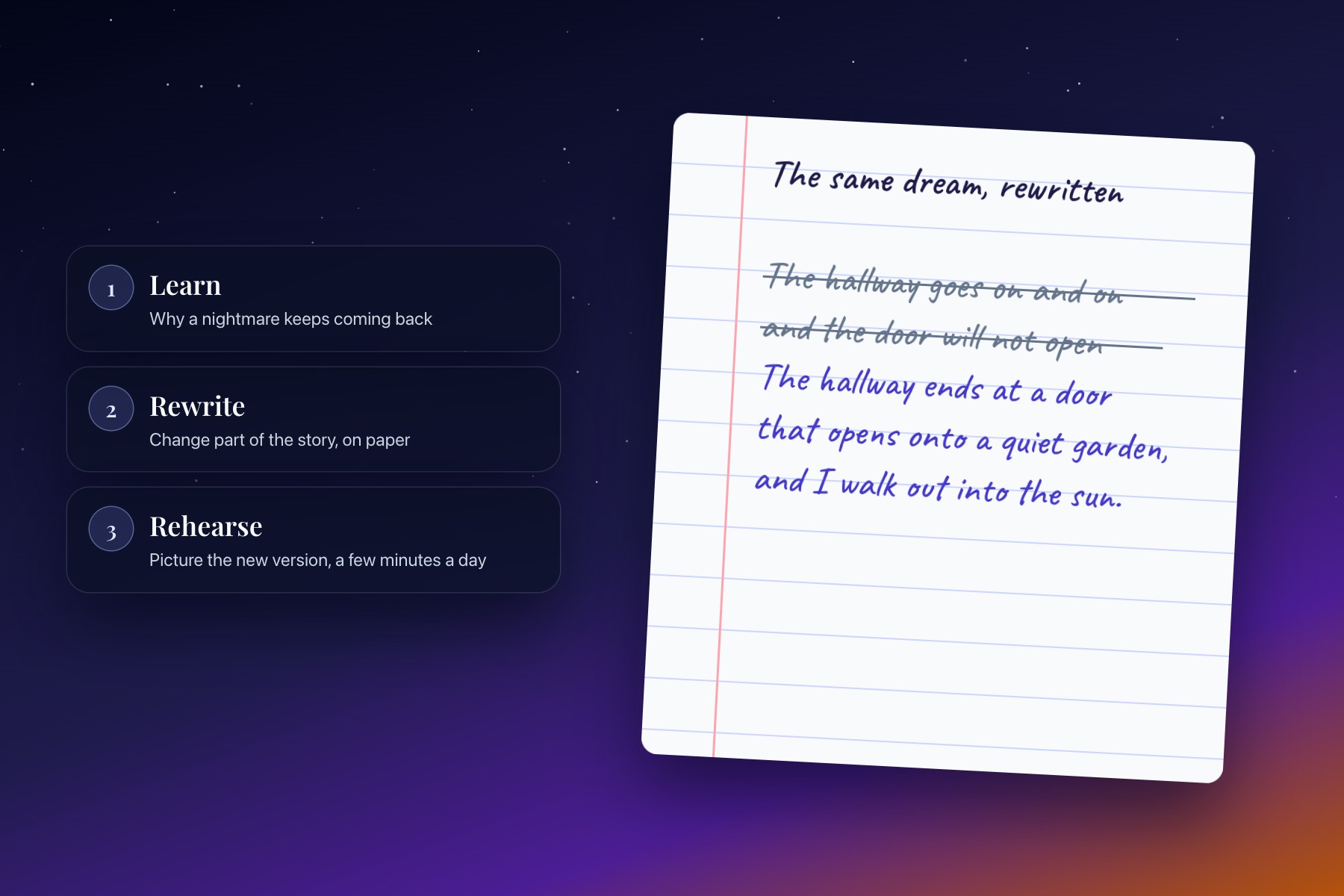
The three steps of imagery rehearsal therapy, learn, rewrite and rehearse, beside a notebook page where a recurring dream has been rewritten.
A recurring nightmare can feel like a script. The same place, the same threat, the same moment you wake up gasping. Night after night, it plays out as if it were written down somewhere.
Imagery rehearsal therapy takes that idea literally. If the nightmare behaves like a script, you can rewrite it.
How it works
The method has three parts, and none of them happen while you are asleep (Casement and Swanson, Clinical Psychology Review, 2012).
First, learning about sleep and nightmares. Understanding why nightmares repeat, and how sleep and stress feed each other, is part of the method rather than a preamble to it.
Second, rewriting. You choose a nightmare and write it down, with a change to some part of the story. The change is yours to decide.
Third, rehearsing. Every day, while awake, you spend a few minutes picturing the new version in your mind.
That is the whole of it. Some programmes built for trauma survivors add further steps, such as writing out the original nightmare and reading it aloud in a group (Casement and Swanson, 2012).
What a course looks like
It is short. In the landmark trial published in JAMA in 2001, it was taught in groups over two 3-hour sessions a week apart, with a 1-hour follow-up three weeks later (Krakow et al., JAMA, 2001). The daily practice at home is where the change takes hold.
What the research shows
That 2001 trial randomly assigned 168 women, survivors of sexual assault and most with moderate to severe PTSD, to imagery rehearsal therapy or a waiting list. The group that learned it had fewer nightmares, slept better and had lower PTSD severity than the group still waiting, and the improvements held at follow-up (Krakow et al., 2001).
A later meta-analysis pulled together 13 studies with 511 participants who had nightmares after trauma. It found large effects on nightmare frequency, sleep quality and PTSD symptoms, and the benefits lasted through 6 to 12 months of follow-up (Casement and Swanson, 2012).
When the American Academy of Sleep Medicine reviewed the evidence in 2018, imagery rehearsal therapy was the one approach it recommended for both nightmare disorder and PTSD-related nightmares (Morgenthaler et al., Journal of Clinical Sleep Medicine, 2018).
Honest expectations
Revisiting a nightmare on purpose, even to change it, can be hard, especially when it comes from trauma. It does not work for everyone, and it can take several weeks of daily practice before the nights change. If you have been living with the same nightmare for years, that is not a long time.
If you are not sure whether your nightmares are frequent or distressing enough to count as a problem, this guide to nightmare disorder explains where the line is.
Day work and night work
Imagery rehearsal therapy does its work in daylight. SleepSafe does its work at night.
While you sleep, SleepSafe watches for the signs of a nightmare on your Apple Watch and responds with gentle taps designed to ease you out of it. In the morning, it shows you what happened, which is exactly what you want to know when you are practising.
Is it working?
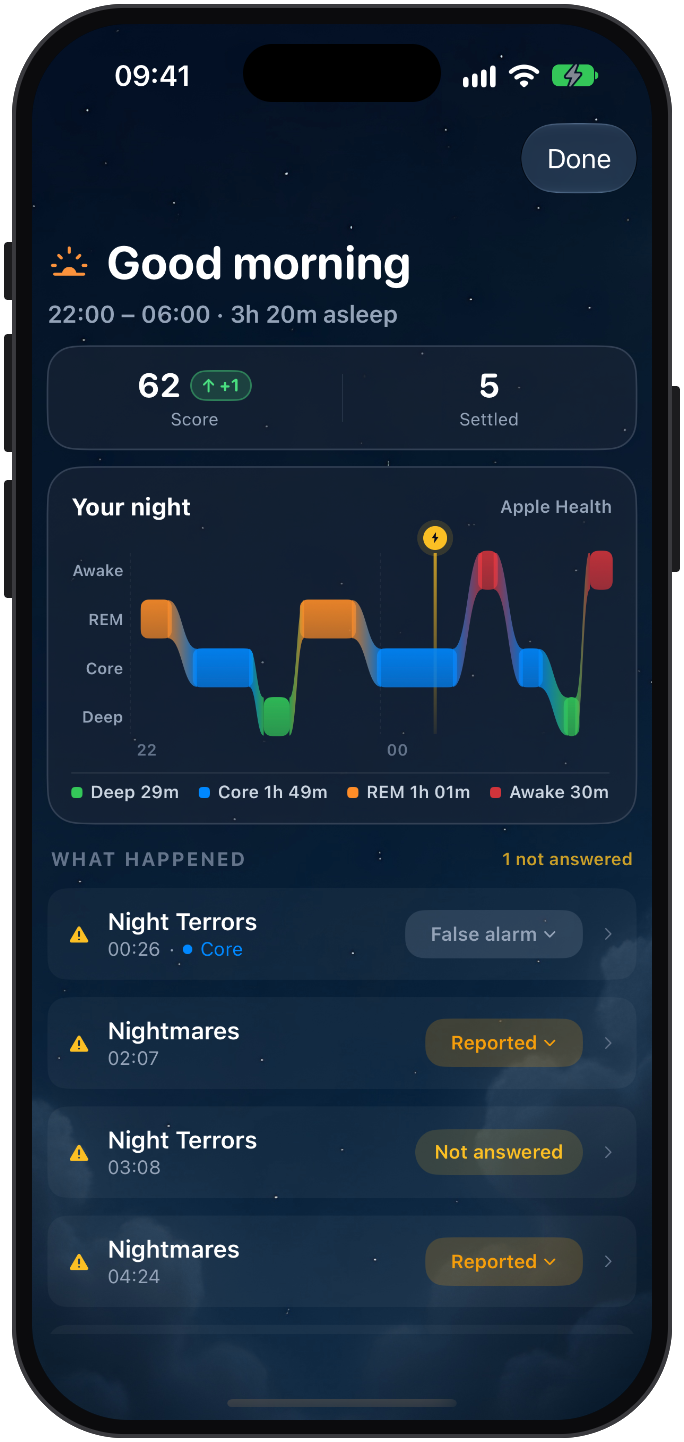
The honest way to tell whether rewriting a nightmare is helping is to count, and to count the same way every night.
SleepSafe's morning report lists what happened overnight: each event, its time, the stage of sleep it came from, and your own answer about whether it was real. A nightmare SleepSafe missed can be added as Reported, so the count stays complete.
Week by week, that list should get shorter. If it does not, you will know that too.
The weeks, side by side
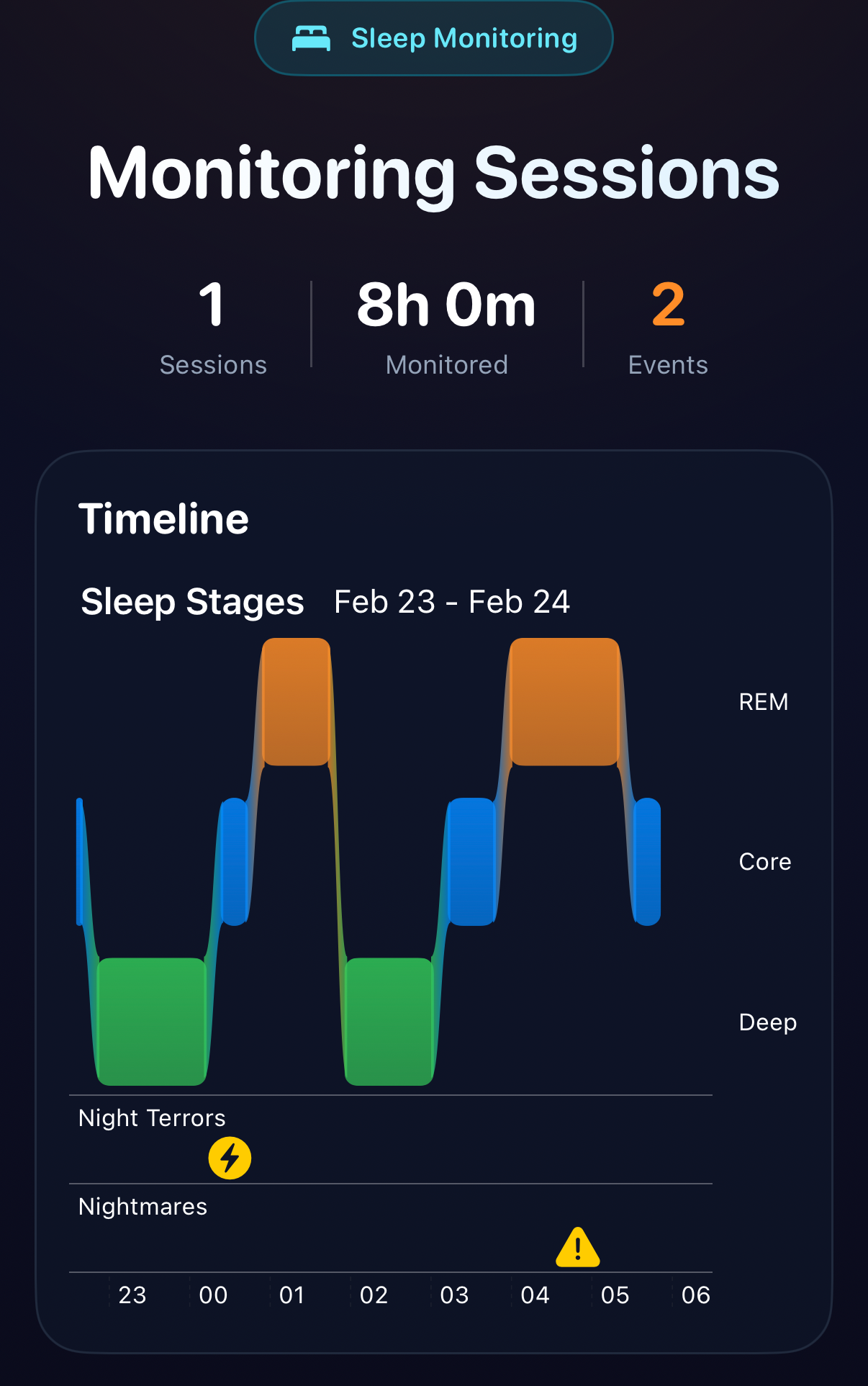
Each night is kept in SleepSafe's history, with its sleep stages and events laid out on a single timeline. Flicking back through the weeks since you started practising shows not only how many nightmares came, but when in the night they arrived.

A nightly sleep score sits alongside it. Fewer nightmares should, over time, mean better nights overall, and the score gives you a simple way to see whether that is happening.
SleepSafe is a wellness app, not a medical device. It does not diagnose or treat any condition.
Common questions
- What is imagery rehearsal therapy?
- A technique for recurring nightmares. You write down a nightmare, change part of the story, and rehearse the new version in your mind every day while awake.
- Does imagery rehearsal therapy work?
- A meta-analysis of 13 studies with 511 participants found large reductions in nightmare frequency and improvements in sleep quality and PTSD symptoms, lasting 6 to 12 months. The American Academy of Sleep Medicine recommends it for nightmare disorder.
- How long does imagery rehearsal therapy take?
- Courses are short. In the landmark 2001 trial, it was taught in two 3-hour group sessions a week apart and a 1-hour follow-up, with daily rehearsal at home.
- How can I tell if it is working?
- Keep a consistent record of your nights. SleepSafe's morning report lists each nightmare with its time and your own confirmation, so you can see week by week whether they come less often.