A child's bedroom at night, calm and secure.
Most of what SleepSafe does is reactive. It waits for the body to show the early signs of a nightmare, then nudges you out of it. Detection first, then a gentle response.
Scheduled wake-ups work the other way around. They don't wait for anything to happen. They get there first.
They are built on one of the stranger facts about night terrors (which, despite the name, are not the same thing as nightmares: here is how they differ): they tend to run on a clock.
The clock
Night terrors rise out of the deepest stage of sleep, in the first third of the night, and they are strikingly regular. Someone who has them tends to have them at roughly the same time after falling asleep, night after night, often inside a narrow window (American Academy of Sleep Medicine).
They are most common in young children, but they are not only a childhood problem. For some people they carry on into adult life: a large general-population study found that around 2 percent of adults still experience them (Ohayon et al., 1999). Whoever has them, that regularity is the same, and it is exactly the thing that makes them treatable.
Getting there first
Sleep clinicians have a name for the intervention that uses that regularity: anticipatory, or scheduled, awakening. You rouse the sleeper briefly, around fifteen to thirty minutes before the terror usually arrives, and let them drift back down. That small, partial waking interrupts the deep-sleep cycle the terror grows out of, so the brain does not slide into it.
It is low-tech and drug-free, and it holds up well. A 2023 systematic review of behavioral treatments for these night-time arousals found scheduled awakening to be one of the most consistently effective options: across the studies that used it, nearly every participant improved, and most stopped having episodes altogether (Mundt et al., Sleep Medicine, 2023). The idea is not new. One early report, published in the BMJ in 1988, used it to settle persistent night terrors in children within weeks (Lask, 1988). Most of the formal evidence is in children, where the problem is most common, but the same method has been used with adults too.
For years the only way to do this was by hand. You set an alarm for 1 a.m., went in, gently roused them, and went back to bed, every night for weeks. It works. It also means someone has to stay on the clock all night to make it happen.
SleepSafe does that job on the wrist, silently, so nobody has to sit up watching the time.
How you set it up
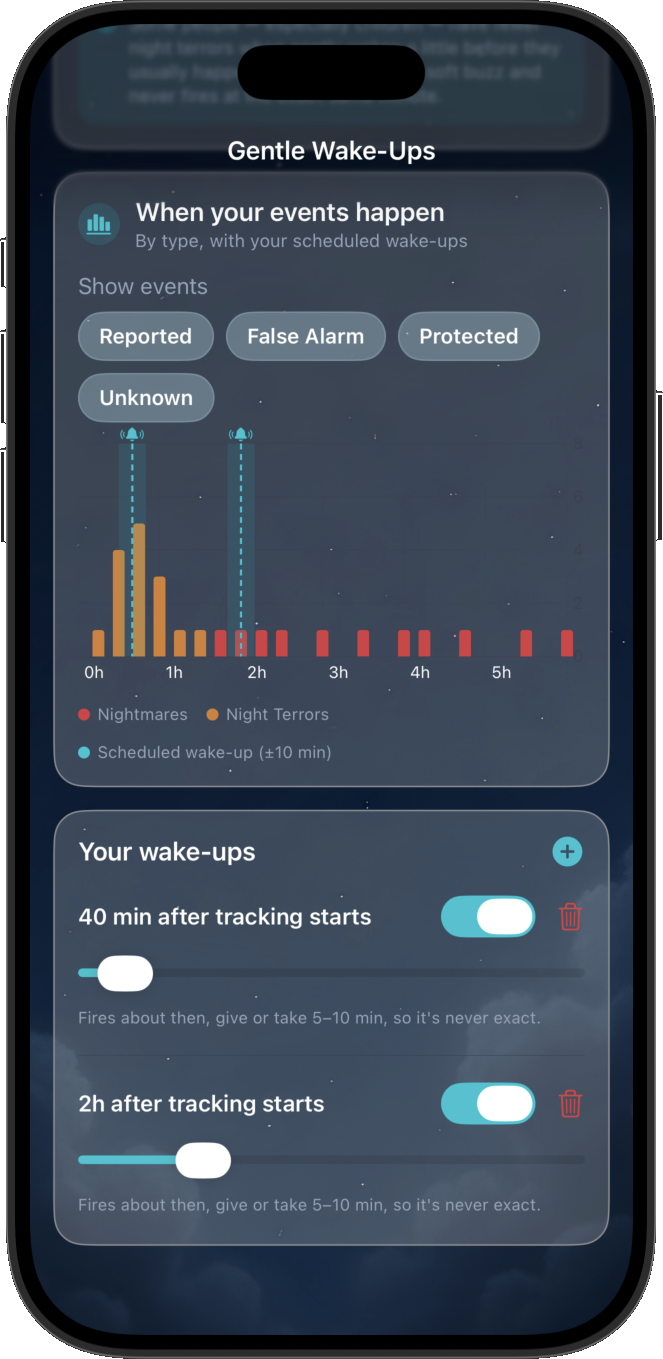
You add a wake-up by dragging a slider: "wake me 40 minutes after tracking starts." Forty minutes is a sensible starting point, and you can set more than one in a night, say one early and another a couple of hours later.
At first you are estimating, and that is fine. But once you have logged a handful of your own events, SleepSafe charts when they actually tend to cluster after you fall asleep, so you can move the wake-up to just before your own peak instead of guessing. Until it has enough to go on, it will not pretend to know your pattern, and that suggestion simply stays locked.
The wake-up itself
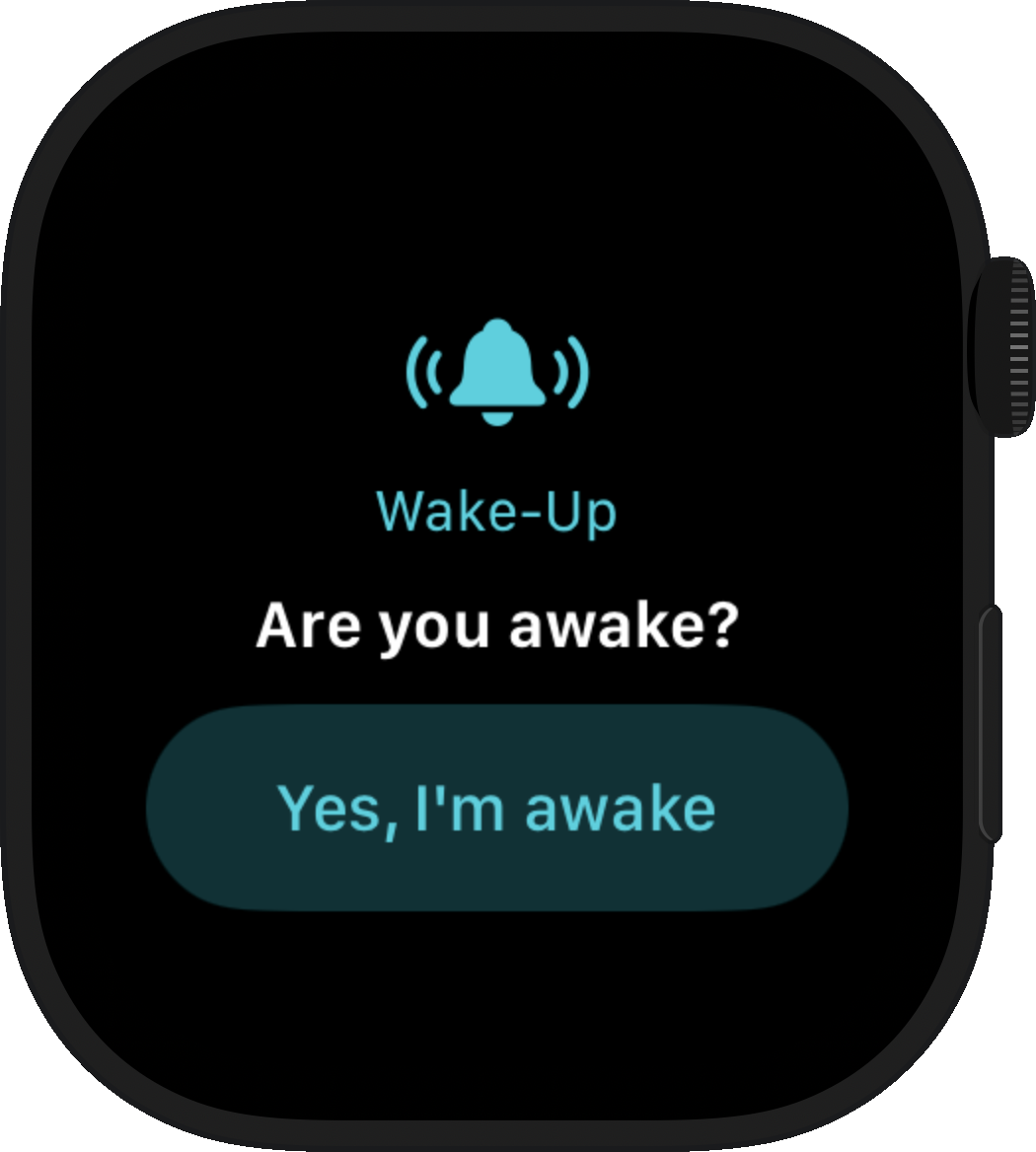
When the time comes, the watch starts a soft, repeating tap on your wrist and asks one question: are you awake? It keeps gently nudging until you answer, or until about a minute has passed. That is the whole of it. A mild buzz, a question, a brief surfacing. Enough to reset the cycle, not enough to start your night over.
One small thing is deliberate and easy to miss: it never fires at exactly the minute you set. SleepSafe shifts it by five or ten minutes each night, on purpose. Bodies are good at learning to sleep through anything that arrives at precisely the same moment every night, so a little randomness keeps the nudge from fading into the background. The app says as much on the setup screen, "give or take 5 to 10 minutes, so it's never exact," because we would rather you trust how it works than a number that is not quite true.
It also always yields to the real thing. If SleepSafe is already handling an actual episode when a wake-up is due, the wake-up steps aside. Prevention should never interrupt the thing it was meant to prevent.
Something the app did for you
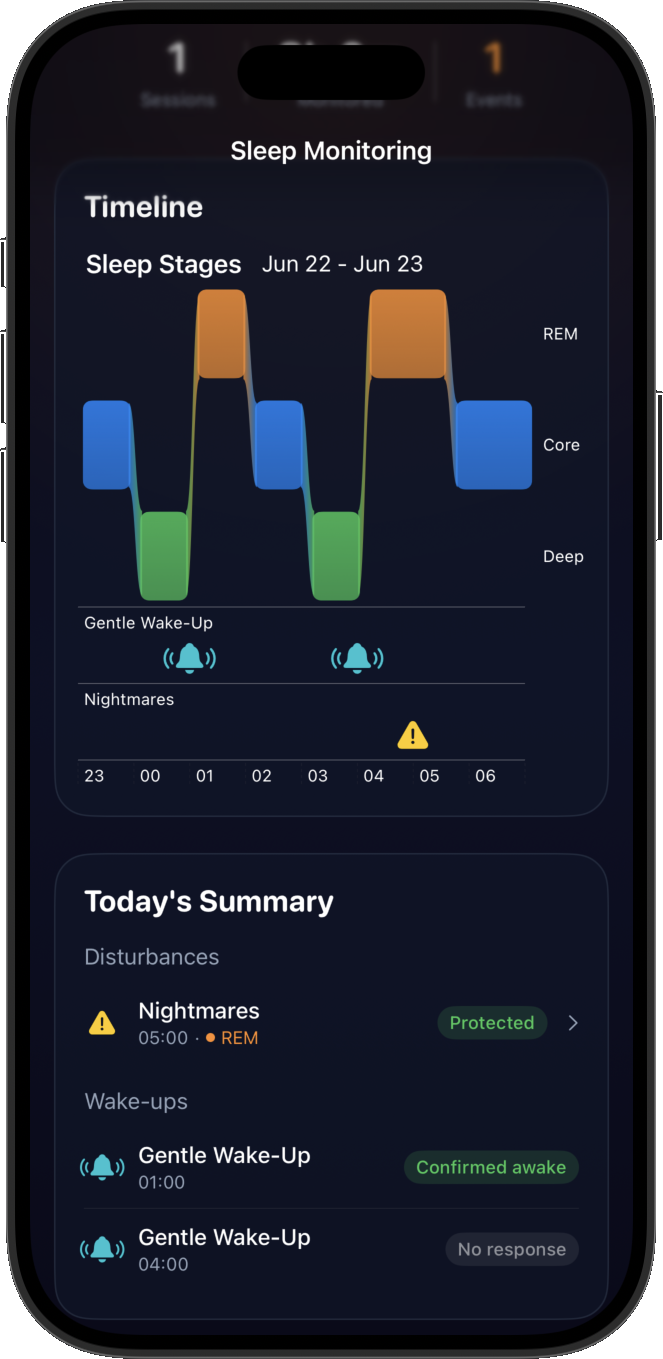
A scheduled wake-up is something the app did for you, not something that happened to you, and the morning summary treats it that way. It sits in its own row, marked as a wake-up, kept separate from anything that actually went wrong, and it does not count against the night's tally.
That was a deliberate choice. The number you wake up to should reflect how your night really went, and a wake-up you scheduled to protect yourself is not a bad night. It is the app quietly doing the job you handed it.
If you have been the one setting the 1 a.m. alarm, for your child, your partner, or yourself, you can hand it over now.
Anticipatory awakening is an established behavioral technique, but persistent night terrors are worth discussing with a healthcare provider. SleepSafe is a complementary tool, not a replacement for professional treatment.