Illustration of a child's bedroom at night, lit by a moonlit window and warm light from an open door.
It usually starts with a scream. You get to the room and your child is sitting up, eyes open, heart pounding, maybe thrashing or shouting words that make no sense. You say their name and nothing changes. They look straight through you.
It is one of the most frightening things a parent can watch. It is also, in most cases, far less dangerous than it looks.
This is a night terror, and the most important thing to know about it is simple: the person having it is still asleep.
What is actually happening
A night terror is not a bad dream. It rises out of deep, non-dreaming (non-REM) sleep, usually in the first part of the night (Cleveland Clinic). The brain gets caught between sleep and waking. The body behaves as if it is in danger, while the mind is not really there. That is why the eyes can be open and the voice can be loud while nothing you say gets through, and why most children have no memory of it the next morning (StatPearls).
Night terrors are most common in children between the ages of 3 and 8, and an episode can last up to 15 minutes (NHS). They are also more common than most parents realise. A long-running study that followed 1,940 children in Quebec found that 56 percent had sleep terrors at some point between 18 months and 13 years of age (Petit et al., JAMA Pediatrics, 2015). Adults have them too: 2.2 percent of a representative sample of nearly 5,000 people in the UK reported them (Ohayon et al., 1999).
If you are not sure whether what you saw was a night terror or a nightmare, here is how to tell them apart.
During the episode
The NHS advice fits in one line, and it is harder to follow than it sounds: stay calm and wait for the person to calm down (NHS).
Don't try to wake them. Someone in a night terror may not recognise you, and trying to wake or comfort them can make them more upset, not less.
Don't hold them still. Unless there is a risk they could hurt themselves, let them move. Restraining someone in the middle of an episode tends to make it worse.
Keep the space safe. Stay close. If they get up, gently guide them away from stairs, furniture and anything they could knock into, without gripping them.
Keep your voice low. You do not need to say anything. If you do, keep it soft and simple.
Then wait. The episode ends on its own, and most people fall straight back to sleep afterwards (Cleveland Clinic).
The morning after
Your child will most likely remember nothing. You will remember all of it, and that is worth looking after too. If you are the one who keeps getting up, this piece is for you.
What makes night terrors more likely
The NHS lists a handful of common triggers: being very tired or unwell, sudden noises at night, needing to pee during the night, and something that has frightened, stressed or worried them. Night terrors also tend to run in families (NHS).
None of these are anyone's fault, and several are easy to nudge. An earlier bedtime on a long day, a trip to the toilet before sleep and a quiet room are small, low-cost things to try.
The technique with evidence behind it
Night terrors have an unusual habit: in someone who has them regularly, they tend to arrive at about the same time after falling asleep. That regularity is what makes scheduled awakening possible.
The NHS describes it plainly. If they are having a night terror at the same time every night, try waking them up 15 minutes before it every night for 2 weeks (NHS). A brief, gentle waking interrupts the deep-sleep cycle the terror grows out of.
The research is encouraging, with honest limits. A 2023 systematic review found that across the studies using scheduled awakenings on their own, every participant improved, and 22 of them stopped having episodes altogether. Most of that evidence comes from children, and in the one randomised trial that compared scheduled awakening with education and reassurance alone, the two approaches did about equally well (Mundt et al., Sleep Medicine, 2023).
The hard part is not the idea. It is setting an alarm for the middle of the night, every night, for weeks, and knowing what time to set it for.
Where SleepSafe helps
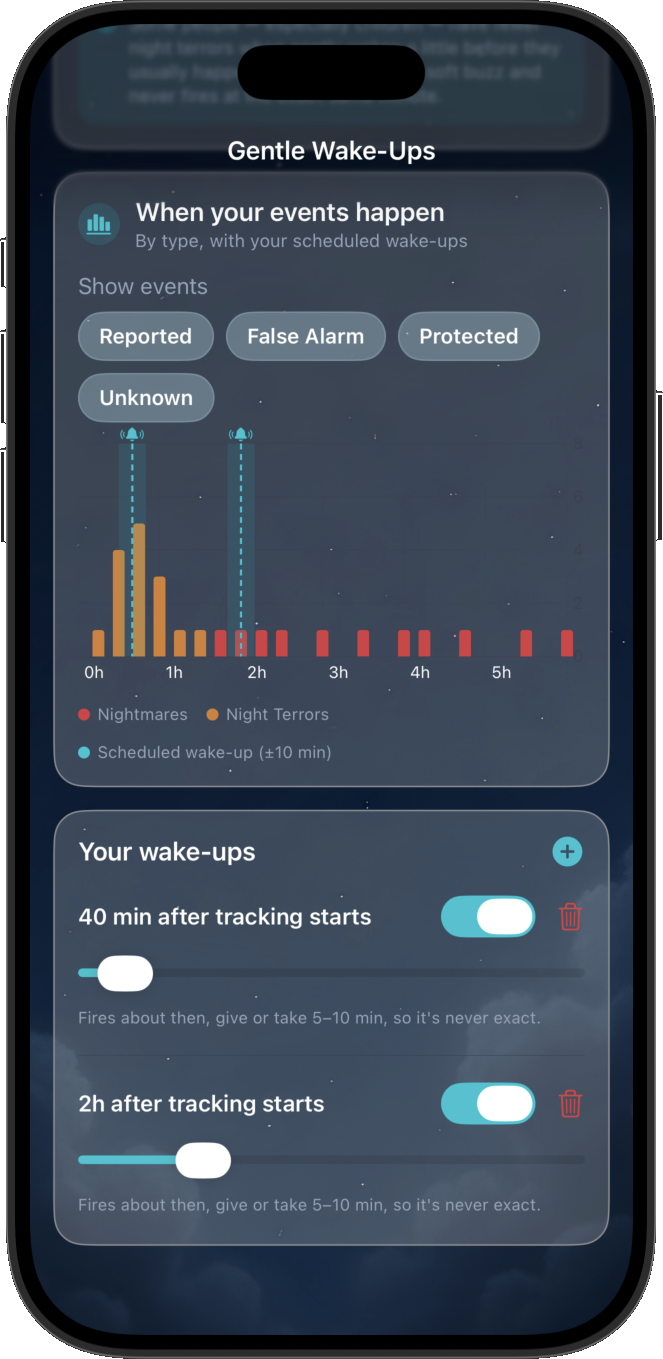
SleepSafe runs on an Apple Watch worn by the sleeper. Through the night it watches for the physical signature of an episode, such as heart rate jumping by 75 beats per minute or more within 30 seconds, and logs when each one happened.
After a few nights, that record answers the question every parent trying scheduled awakening needs answered: what time? SleepSafe charts when the episodes cluster after falling asleep, so you can place a wake-up just before the usual time instead of guessing.
You set a wake-up by choosing how long after tracking starts it should come, and you can add more than one in a night.
The wake-up itself
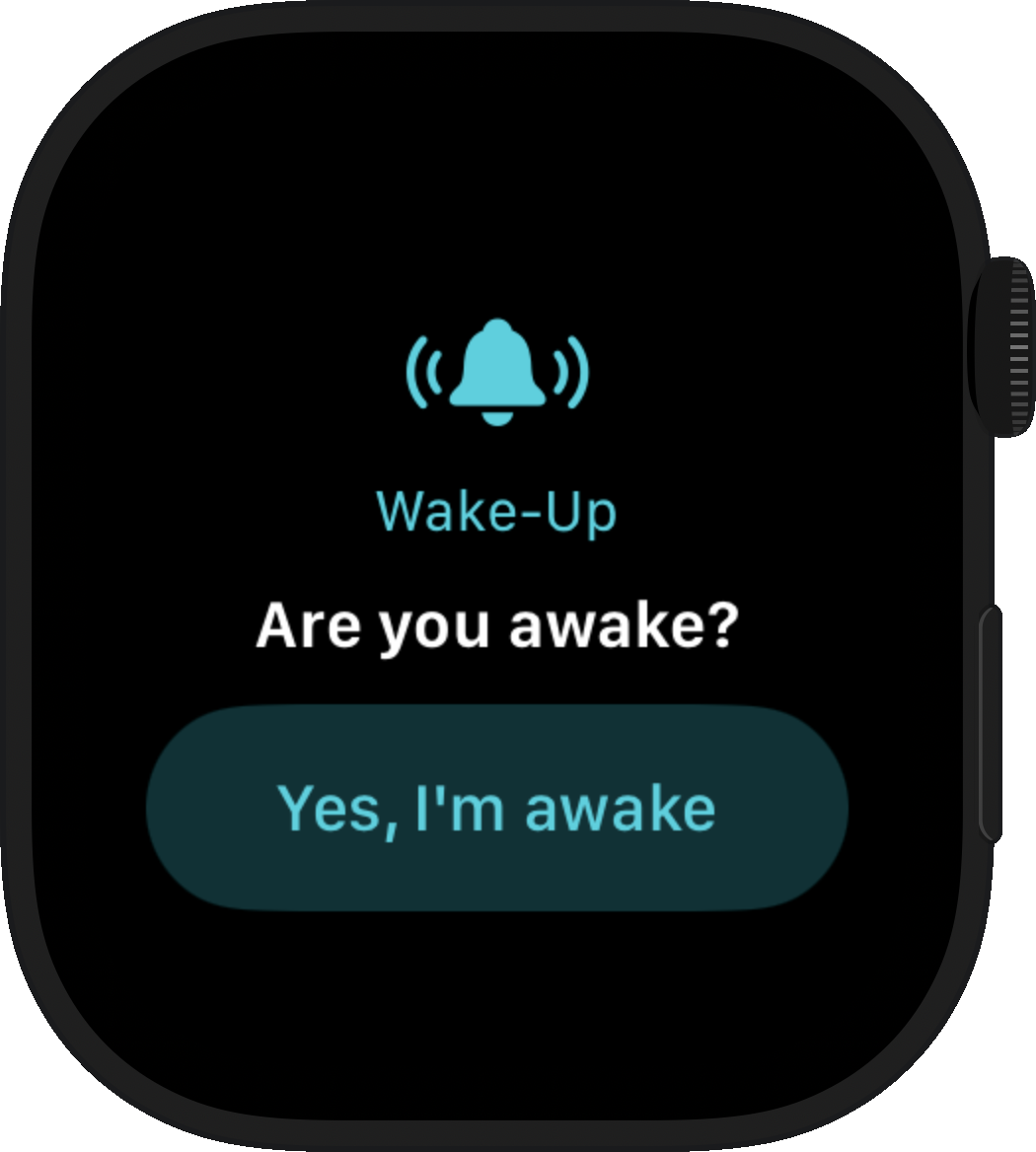
When the time comes, the Watch starts a soft, repeating tap on the wrist and asks one question: are you awake? It keeps gently nudging until there is an answer, or until about a minute has passed. Enough to reset the cycle, not enough to start the night over.
It never fires at exactly the same minute. SleepSafe shifts each wake-up by five to ten minutes every night, so the body does not learn to sleep through it. And if SleepSafe is already responding to a real episode when a wake-up is due, the wake-up steps aside. Here is the thinking behind the feature.
In the morning
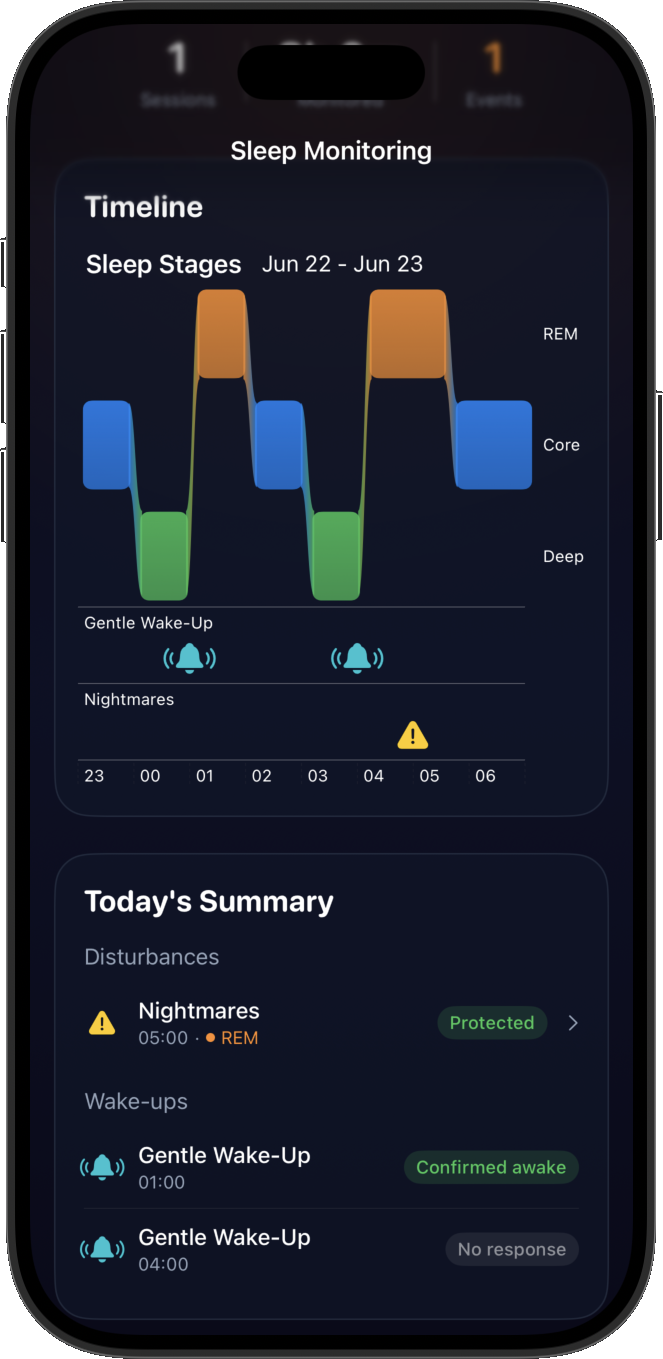
Each wake-up appears in the morning summary on its own row, marked Confirmed awake or No response, and kept apart from anything that actually went wrong. It does not count against the night.
Over a couple of weeks, those rows tell you whether the wake-ups are landing at the right time, and whether the nights are getting quieter.
It does not replace the calm person in the doorway. It takes the clock-watching off your hands.
SleepSafe is a wellness app, not a medical device. It does not diagnose or treat any condition.
Common questions
- Should you wake someone during a night terror?
- No. The NHS advises against trying to wake them, because they may not recognise you and can become more upset. Stay calm, keep them safe, and wait for the episode to pass.
- How long does a night terror last?
- Usually a few minutes, and up to about 15 minutes. Most people fall back to sleep afterwards and do not remember it.
- Can night terrors be prevented?
- Scheduled awakening is the best-studied behavioural approach: gently waking the sleeper shortly before their usual episode time each night. The NHS suggests 15 minutes before the usual time, every night for 2 weeks.
- Do adults get night terrors?
- Yes. They are most common in children aged 3 to 8, but around 2 percent of adults report them.